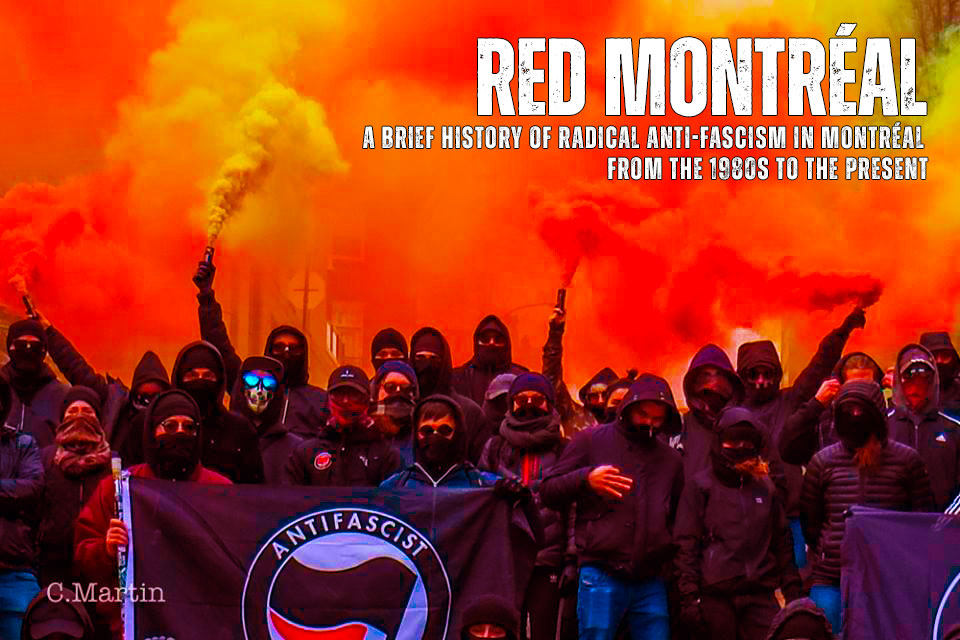
This article was prepared by the Montreal Antifascist Collective for the Spring 2026 issue
of the journal Possibles (Vol. 50 No. 1), “Extrêmes droites”*, edited by Tristan Boursier and Frédérick Nadeau.
SUMMARY
This article traces the history of radical anti-fascism in Montréal, highlighting the dynamics of the grassroots self-defence that has emerged in response to racist, homophobic, and neo-Nazi violence since the late 1980s. Drawing on activist testimonies, it documents the origins of collectives such as the Ligue antifasciste de Montréal (LAM), SHARP, RASH, Anti-Racist Action–Montréal (ARA), and Antifa-Montréal. The text highlights the roots of these movements in subcultures (punk, skinhead), as well as in community, anarchist, and Marxist circles. The analysis highlights internal tensions (e.g., the state’s cooptation of LAM) and strategic adaptations in response to the evolution of the far right, particularly its shift toward identitarian politics and metapolitics at the turn of the 2000s. The article focuses on militant tradition, alternative culture, and popular education as levers of mobilization, leading up to the recent creation of the Front antifasciste populaire (Front Pop) in 2025. Against the backdrop of the normalization of far-right discourse, it advocates for a broader anti-fascism rooted in a working-class and trade union circles to counter contemporary political and social regression.
Little-Known History
Whatever definition one gives to fascism, anti-fascism is always reflexive popular self-defence. It was within the socialist, communist, and anarchist movements—the primary targets of the fascists—that this reflex was first honed. From the 1920s onward, as historical tides have ebbed and flowed, this anti-fascist reflex has been ceaselessly cultivated and more widely developed, sometimes at great cost, with these movements not only opposing fascism but also seeking to overthrow the oppressive bourgeois order. This is the legacy of radical anti-fascism we will be addressing here.
The following article offers a brief overview of the many groups and projects that have emerged within this tradition in Montréal from the late 1980s to the present. It is based on a dozen interviews conducted in June 2025 with activists who are or have been directly involved in the various collectives discussed here. This text is intended as a modest contribution to the transmission of a little-known history, primarily for the movement itself, but also for those who are interested in the history and who will hopefully be inspired to take action.
Unfortunately, space constraints oblige us to omit many details that would add colour and flavour to this account. We, nonetheless, hope that this summary, produced for Possibles, will serve as the starting point for a more comprehensive overview that will eventually be made available on the website http://www.montréal-antifasciste.info or in another format.
We Had to Defend Ourselves
In the late 1980s and early 1990s, a number of violent white supremacist groups were active in Montréal, including several neo-Nazi bonehead gangs and an official chapter of the Ku Klux Klan. Assaults were commonplace in Montréal, generally following a predictable pattern, with people of colour, Jews, members of LGBTQ community, and marginalized groups bearing the brunt of the violence. For a time, neo-Nazis even ran a shoe store on Saint-Denis Street, and their crew spread terror in some city neighbourhoods, without drawing much police attention. In the fall of 1992, two men were beaten to death by boneheads in what turned out to be an initiation rite involving hunting down gay men in parks and brutalizing them. The LGBTQ community, correctly anticipating complacency and inaction on the part of the Montréal police, organized self-defence patrols in the Village.
By that point, young Haitians have been organizing to defend themselves against bonehead attacks for several years, first in shared spaces in the city center and on public transit, and eventually in the neighbourhoods where the Haitian community was concentrated, as is documented by Maxime Aurélien and Ted Rutland in their book Il fallait se défendre. This self-defence movement, which grew increasingly vigorous over the years, reached its peak on May 12, 1990, when an attack orchestrated by some fifty boneheads against young Blacks at the La Ronde amusement park escalated into a massive brawl that spread from the metro into downtown, in what proved to be a humiliating defeat for the neo-Nazis.
The racism and homophobia that were then rampant in Québec society manifested themselves in the unbridled violence of the most fanatical elements of that society. Since the authorities—primarily the police—not only did nothing to curb this violence but often actively participated in it, the targeted groups had no choice but to organize their own response.
This was the reality that led to the formation of the first explicitly anti-fascist collectives in Montréal, particularly within the punk and skinhead scenes, which, at the time, had to defend themselves from both neo-Nazi violence and attempts by neo-Nazis to infiltrate their countercultural spaces. They, too, couldn’t rely on police assistance, as no one expected the police to have the slightest sympathy for marginalized youth. It was in the context of this simmering conflict that Montréal’s anti-fascist movement began to take shape in the late 1980s.
From “Punks and Skins United” to “Cops and LAM Go Hand in Hand”
As Acouetey Junior Jocy explains in his book, Poseurs? Scalpeurs de skins de la LAM, it was under the influence of the French redskin movement—and modeled after gangs like the Red Warriors and the Black Dragons—that he and his friends initially conceived the Ligue antifasciste de Montréal (LAM) in the summer of 1989. Fed up with repeated attacks, they organized patrols to drive the boneheads out of contested spaces and formed security teams to ensure safety at concerts. This small group of friends rapidly gained a reputation, and in October of that year the legendary French band Bérurier Noir asked them to provide security for their farewell concerts in Montréal. On that occasion, they successfully repelled a violent attack launched by some fifty boneheads. This incident, which received significant media coverage, brought LAM sudden attention, both from young people wishing to join the struggle and from the police, who were concerned that the situation would further accelerate. Unfortunately, under pressure from various actors—including the police—to become more respectable, the LAM leadership publicly renounced its mission of popular self-defence and refashioned itself as a formal, “legitimate” anti-racist organization, with a high-profile presence, media relations, a bureaucratic structure, and public funding. Overunning with modesty, the directors renamed the project the Ligue antifasciste mondiale.
One consequence of this sustained collaboration with the police was LAM’s increasingly toxic hostility toward left-wing anti-fascist initiatives, which undermined its attempt to monopolize the anti-racist struggle. The unhealthy competition that resulted gave rise to a long series of acrimonious incidents beginning in the summer of 1990 and culminating in the summer of 1996, when the LAM leadership—by this point inextricably compromised by its collusion with the police, its dependence on subsidies, and its director’s involvement in core structure of the Parti Québécois—publicly provided provincial police with the (incorrect) names of anarchist activists they claimed were involved in the Saint-Jean-Baptiste Day riot in Québec City. Obviously, this damaging debacle had a major impact on Montréal’s anti-fascist community that would not soon be forgotten.
The Foundations
Around the same time, other anti-racist groups with a more political focus emerged. The Groupe Action Socialiste, a Marxist-Leninist organization, became fully engaged in the anti-fascist movement, while the Canadian Centre on Racism and Prejudice (CCRP, founded in 1989)—firmly rooted on the left but without any specific affiliation—provided strong leadership. In the early months of its existence, the CCRP organized the first anti-fascist popular assembly held in Montréal since World War II—in Pointe St. Charles, it’s worth noting. The group was a pioneer in intelligence gathering and anti-fascist organizing in Québec and Canada. It collaborated with similar projects abroad and developed or supported numerous anti-racist coalitions and campaigns at home, including a solidarity campaign with the Mohawks during the 1990 Oka Crisis, that included, among other things, publicly denouncing the role played by the KKK in public agitation against members of Indigenous nations.
On the anarchist side of things, the committee Un Québec pour tout le monde was formed in the early 1990s, primarily around a small group of libertarian socialist activists, including people associated with the newspaper Rebelles (published from 1989 to 2001). The committee operated horizontally, without a leader or spokesperson, and refused to collaborate with authorities in any way. The collective, which was close to established community and activist circles, focused primarily on grassroots mobilization rather than direct action. In particular, it organized consciousness-raising events, benefit concerts, and an annual demonstration on March 21, marking the International Day for the Elimination of Racial Discrimination. At the time, SHARP (anti-racist skinheads) was regularly called upon to provide security for these events.
Redskins and Anti-Racist Skinheads
Space does not permit us to elaborate on the rich history of the anti-fascist skinhead movement, but any overview of contemporary anti-fascist movements would be incomplete without a special mention of the skinheads. In fact, in many respects, they formed the backbone of the anti-fascist movement in Montréal for most of the period covered by this article and remain a central component to this day.
By the late 1980s, SHARP (Skinheads Against Racial Prejudice) had established a presence in Montréal, forming a distinct subculture strongly influenced by the working-class and multiethnic origins of the skinhead movement. SHARP stands in radical opposition to the cooptation of the skinhead movement by supremacist and neo-Nazi organizations, a process that began in the 1970s, first in the UK, and then gradually in the rest of the Western world. While not part of any specific political culture, SHARP adhered to a resolutely anti-racist ethos and participated organically in anti-fascist circles, here and elsewhere.
As for the redskins, they are, as their name suggests, anti-racist skinheads aligned with the far left. Since the historical birthplace of this movement was urban France in the mid-1980s, it comes as no surprise that the first redskins in Montréal were French expatriates. Indeed, it was members and associates of the punk band Nuclear Device, originally from Le Mans, who, together with local anti-racist skinheads, formed the first RASH (Red Action Skinheads) collective in Montréal in 1994, one year after the founding in New York of the very first RASH (Red and Anarchist Skinheads). This first iteration of RASH Montréal—certainly more red than black, hence the subtle variation in the name—was notably responsible for the Big Fiestas, a series of explicitly anti-racist and anti-sexist dance parties, conceived both as spaces to politicize the scene and pretexts for parties combining punk subgenres with Latin, ska, reggae, and hip-hop sounds.
A specific set of circumstances would trigger a surge in activity among anti-racist skinheads. Between 1996 and 1998, two neo-Nazi gangs, the Vinland Hammerskins and the Berzerker Boot Boys, launched a series of armed attacks in Montréal bars. The boneheads ran rampant in Montréal, randomly attacking young people on the street, LGBTQ and racialized individuals, and anyone suspected of holding anti-racist views.
As a result, the skins were called upon to provide security at demonstrations and to ensure safety at concerts and events organized by other sections of the radical left. Working with activists from Anti-Racist Action–Montréal (ARA), whose first chapter was founded in 1997 (more on this below), SHARP helped clean up the streets of Montréal during this period. For several years, neo-Nazis and anti-racists engaged in “chases” in downtown neighborhoods on a weekly basis, with the stakes always high and the outcome uncertain.
This series of events culminated in September 1998 with the arrest of eight boneheads and the filing of 240 charges related to four incidents that occurred between March and June of that year. This marked a major setback for the neo-Nazis of that generation, but they would not disappear entirely for several more years, despite constant pressure from anti-fascist groups.
Amid the anti-capitalist fervour that characterized the run-up to the Summit of the Americas in Québec City in April 2001, a second RASH collective was formed, this time with a more libertarian orientation and comprised of younger activists, including politically engaged SHARP members. Highly active in the cultural sphere, this new RASH organized numerous concerts and revitalized the local skinhead scene. Several music groups were affiliated with it or operated within its orbit. From 2001 to 2006, the collective ran a concert venue on the second floor of the building occupied by the anarchist bookstore L’Insoumise on Saint-Laurent Street. At the same time, it forged closer ties with the Northeastern Federation of Anarcho-Communists (NEFAC) and contributed to the anarchist newspaper Le Trouble. Managing the space, however, led to a certain degree of burnout within the collective, which found itself torn between its cultural and political implications.
A third RASH collective was formed in 2007, once again with younger activists eager to breathe new life into the project. This third RASH continued the work of its predecessors and joined forces with other anti-fascist groups to drive the remaining boneheads off the streets. During this particularly dynamic period, RASH launched its own fanzine, Casse sociale (16 issues published to date), and actively contributed to various political struggles, including the annual May Day demonstration, the popular mobilization against the G20 in Toronto in 2010, and the Maple Spring. It collaborated with the Convergence des luttes anticapitalistes (CLAC) and the Union communiste libertaire (UCL), and, beginning in 2013, forged a close alliance with the local chapter of the Industrial Workers of the World (IWW). In 2010, the Montréal Sisterhood was founded, which would help combat persistent sexist tendencies within the skinhead scene and promote feminist values. This iteration of RASH is, in fact, more gender-balanced than any of its predecessors.
RASH organizes numerous concerts, and since 2013 has held the annual Revolution Fest (nine editions to date), a festival of music and revolutionary culture that spans several days and largely follows the format of the Big Fiestas. It also serves as an opportunity for RASH to build connections with the local anti-fascists and other anti-fascist collectives in North America and Europe.
RASH would re-emerge in the 2010s and take part in the anti-fascist protests of the 2016–2020 period.
ARA—Anti-Racist Action–Montréal
The Anti-Racist Action network had already been in existence for about a decade in the United States and had already established itself in English Canada when the first local chapter was founded in Montréal. This network had been created in the late 1980s by anti-racist skinheads in major cities in the American Midwest, including Minneapolis and Chicago, whose counterculture scenes were then plagued by the infiltration of neo-Nazi organizations (e.g., White Aryan Resistance), which instrumentalized local boneheads. Through rigorous and sustained political organization, the ARA network expanded to dozens of cities across North America. Its decentralized collectives were united by a four-point platform that was anti-authoritarian in nature, shared publications, intercity mobilizations, and annual conventions aimed at determining their direction.
The first ARA–Montréal collective was formed in 1997, when an activist from ARA–Edmonton moved to Montréal and joined a small group of anarchist activists associated with the Collectif opposé à la brutalité policière (COBP, founded in 1995) and the newspaper Démanarchie (published from 1994 to 1997). It was in the particularly hostile environment described above that ARA–Montréal first saw the light of day, focusing primarily on gathering intelligence and disrupting the bonehead organizing as much as possible. Although initially operating as a small informal group with shared values, the collective managed to organize several effective actions, including the spectacular disruption of a neo-Nazi concert in the city’s southwest in February 1998 by several hundred anti-fascists. The group published informational leaflets and distributed zines produced by other ARA chapters, including the Toronto chapter, which was particularly active. Its members, who were deeply rooted in the community, also engaged in copwatch, which involved documenting police repression from a perspective of community self-defence. Like RASH and SHARP, with whom the collective regularly collaborated, ARA–Montréal was part of the local counterculture, notably organizing benefit concerts featuring politically engaged bands.
In the very late 1990s, activists affiliated with ARA–Toronto came to Montréal to study at McGill University. When the collective received working group status from McGill’s Public Interest Research Group (QPIRG), ARA–Montréal experienced significant growth. This new dynamic had several effects. It allowed the project to expand and diversify its membership, as well as providing additional resources and new energy. However, while maintaining its radical nature and its commitment to political action, moving away from an affinity-based organizational model left the collective vulnerable to certain risks, including infiltration by police informants.
This is partly why ARA–Montréal split up in the early 2000s, with one group remaining at McGill and another opting to return to the affinity-based organizational model characteristic of Montréal’s libertarian circles. The two projects evolved in parallel for a time, but the McGill group gradually lost its organic ties to the local activist scene and eventually disappeared, and the small affinity-based ARA collective gradually crumbled under the strain of internal tensions.
A new ARA–Montréal collective was formed in 2007 at the instigation of a small group of young anarcho-punks from the southwest of the city. This new iteration of the project, rather than focusing on direct action—which, in any case, was being handled by RASH and the new Antifa-Montréal collective (more on this below)—concentrated on intelligence gathering and grassroots education, notably by resuming the production of a newspaper, Radar (two issues published), collaborating on other information projects (including Québec Fachowatch; more on this below), and privately distributing sensitive information to those who would know what to do with it. Furthermore, this collective distinguished itself politically from its predecessors by incorporating new concerns that reflected its composition, including defending the rights of sex workers and drug users, who, in addition to being marginalized by the far right and the state, are also marginalized by a segment of the radical left. This final iteration of ARA–Montréal gradually lost momentum and faded away amid the wave of activist burnout that characterized the years following the 2012 student general strike, which evolved into the so-called Maple Spring.
Antifa-Montréal et NTFA
The years 2005–2008 saw a resurgence of neo-Nazi activity on the streets of the Hochelaga-Maisonneuve neighborhood, with the formation of Strike Force, a crew of young boneheads linked through their leader to the gangs that came before them. In August 2008, when he was only seventeen years old, the leader of Strike Force and an accomplice attacked a group of Arabs walking on Sainte-Catherine Street: he stabbed two of them and also assaulted two taxi drivers while fleeing. The same individual would remain a central figure in the neo-Nazi scene for several years, including during the identitarian shift that occurred at the turn of the decade.
This development led to the creation of the Antifa-Montréal collective in 2006. This new initiative, which emerged from an informal grassroots committee, had a strong cultural dimension and was deeply rooted in the Hochelaga-Maisonneuve neighbourhood. Its primary goal was to drive the neo-Nazis out of Hochelaga-Maisonneuve once and for all. Given the emphasis on direct action that accompanied its public cultural activities, Antifa-Montréal had an affinity-based organizational model that involved preserving the anonymity of its members and adopting strict security protocols. Its activity included community education, organizing patrols, and promoting anti-fascist visibility in the neighborhood, primarily through posters and graffiti. This latter activity eventually became significant enough for the collective to form a dedicated crew: NTFA.
Culturally speaking, although the collective included skinheads (it is in this scene, in fact, that the third iteration of RASH and the Montréal Sisterhood originated), it also included activists who identified with other countercultures and wished to push the anti-fascist movement out of the skinhead niche. As such, the concerts organized by the collective brought together artists from different musical genres, and its visual communication had a style that reflected hip-hop aesthetics.
After playing a major role in cleaning up the city, Antifa-Montréal gradually scaled back its activities during the 2010s. The graffiti crew, meanwhile, continued to leave its mark on the city, using the letters NTFA, a signature that originated in Montréal and rapidly spread across the planet.
Québec Fachowatch
Starting in the mid-2000s, following the lead of the French Nouvelle Droite, Québec’s far right took a metapolitical and identitarian turn. The boneheads of yesteryear sought to reinvent themselves, notably by superficially abandoning biological racism in favour of the more sophisticated rhetoric of cultural racism. The Fédération des Québécois de souche (FQS)—which never truly managed to hide its neo-Nazi roots—was founded in 2007, followed by other short-lived projects, including Légion nationale, 3e Voie Québec, and La Bannière noire. A few years later, this last splinter group, inspired by revolutionary nationalism and the Italian neo-fascism of the CasaPound movement, would serve as a model for Atalante Québec.
This strategic shift was meticulously documented on the Québec Fachowatch website (fachowatch.com) from 2011 to 2013. Run by a tight-knit core of anarchist activists inspired by the Fafwatch project in France, with the support of a small army of anti-fascist researchers who provide them with intelligence, the site featured numerous articles mapping the Québec far-right of this period, including the nebulous network of neo-Nazi music groups and various fascist splinter groups, and also explored the links between past and then current organizations. The site’s aim was both to inform the anti-fascist movement and to encourage the mainstream media to cover far-right movements with greater rigour. This site was, in fact, a precursor to the work carried out by the Montréal Antifasciste collective today. Unfortunately, the site’s content was lost in 2013, although most of it can now be found on Archive.org.
2017 to Today
In 2016, there was a far-right resurgence of international proportions, and Québec was no exception. The MAGA movement succeeded in getting Donald Trump elected in the United States, and various reactionary online currents converged to consolidate the metapolitical movement now known as the alt-right (a movement characterized by paleoconservatism and unabashed racism and influenced by the European Nouvelle Droite, with fascist and neo-Nazi elements at its fringes). In Québec, this was the year new Islamophobic (La Meute), ultranationalist (Horizon Québec Actuel), neo-fascist (Atalante Québec), and neo-Nazi-inspired (Soldiers of Odin) groups were formed. On January 29, 2017, the Québec City mosque shooting occurred, and just a few weeks later La Meute organized a series of Islamophobic demonstrations in Québec cities, including one in Montréal, marking the first time in decades that the far right had successfully taken to the streets of the city (with a heavy police escort).
This stunning setback sent shockwaves through the anti-fascist community. The Montréal Antifasciste collective, which is firmly rooted in the local radical left, was formed in the spring of 2017 and helped establish a coalition against hate and racism, which organized its first major march in downtown Montréal in November of that year, followed by another in October 2018 in the wake of the election of the Coalition Avenir Québec (CAQ). Numerous mobilizations and counter-demonstrations were organized during this period, notably at the Saint-Bernard-de-Lacolle border crossing, which contributed significantly to the defeat of organizations like La Meute and Storm Alliance. Montréal Antifasciste has also conducted in-depth research and has published dozens of articles on its website mapping out the main actors and groups that make up Québec’s far right—always with a focus on self-defence and grassroots education. Significantly, this work helped expose a prominent Montréal-based neo-Nazi propagandist and seriously destabilized the neo-fascist organization Atalante Québec.
The student milieu also mobilized. At Concordia University, activists set up the Resist Trump network, from which the Food Against Fascism collective emerged—a food service and community education project that continues to this day. At UQAM, the Bloc antifasciste de surveillance contre la haine (BASH UQAM) was formed to reignite the anti-fascist spirit within the student community, defend the university sector, and pass on certain practices to younger activists. Though short-lived, it would spur other projects. A new generation emerged, particularly within the anti-racist skinhead movement, notably Jeune Garde, which remained active for several years before merging into other anti-fascist projects. RASH also remained a cultural and activist reference point during this period through its annual organization of Revolution Fest and sustained participation in anti-fascist mobilizations.
On the cultural front, the Black Flag Combat Club, a sports and training club founded in 2015, has grown stronger over the years and become a key hub of Montréal’s anti-fascist movement, playing a particularly crucial role in the self-defence of the trans community, which has come under intense attack in recent years. Contested cultural spaces have also been successfully reclaimed by anti-fascists. This includes, for example, the role the 132 Crew plays representing the anti-racist movement among supporters of the CF Montréal (Impact) ultras, following in the footsteps of its predecessors in the Front Commun Montréal, whose members organized an annual anti-racist soccer tournament for several years running.
A History We Must Write Together
Anti-fascism remains a central pillar of activist organizing in Montréal. It would, however, be an error to be satisfied with our relative successes. After two terms marked by a denial of systemic racism, a form of nationalism rooted in identitarian politics, and a distortion of the principle of secularism focused on the repression of religious minorities, the CAQ is showing an increasingly tendency to scapegoat (im)migrants in an absolutely crude fashion for all the ills for which the political class alone is responsible: the housing crisis, inflation, etc. As the next election cycle approaches, this “autonomist” nationalist party is engaged in a bidding war with the PQ over “acceptable” immigration thresholds, with both parties adopting elements of the far-right agenda advanced by ethno-nationalist ideologues.
Faced with a situation in which the far right is insidiously infiltrating mainstream political currents and media discourse is influenced by populist and fascist-leaning politics, with the demonization of (im)migrants and religious minorities becoming increasingly brazen and fundamental rights being eroded here, just as they are elsewhere, anti-fascism alone, even in its most radical expression, is no longer sufficient to stem the tide.
Anti-fascism must necessarily take on a grassroots dimension and become normalized as broadly as possible in student organizations, community groups, trade unions, etc., as well as in neighborhood assemblies, workplaces, personal and family settings, and so on. We must use all means at our disposal to make it an indispensable factor in the public sphere and a persuasive alternative to the prevailing anti-woke ideology that ultimately only serves to undermine struggles for equality, inclusion, and justice.
It was precisely in this spirit that the Front antifasciste populaire, an initiative aimed at extending anti-fascism beyond activist networks and broadening the concept of popular self-defence, was created in 2025. The main challenge to such a project will perhaps prove be preserving the radical dimension of anti-fascist politics. It is, nonetheless, a necessary task, for history teaches us that as long as capitalism and the many systems of oppression and domination associated with it remain in place the eventual resurgence of the far right and fascism is a constant threat.
This story isn’t over yet, and it’s up to all of us to write the next chapters together.
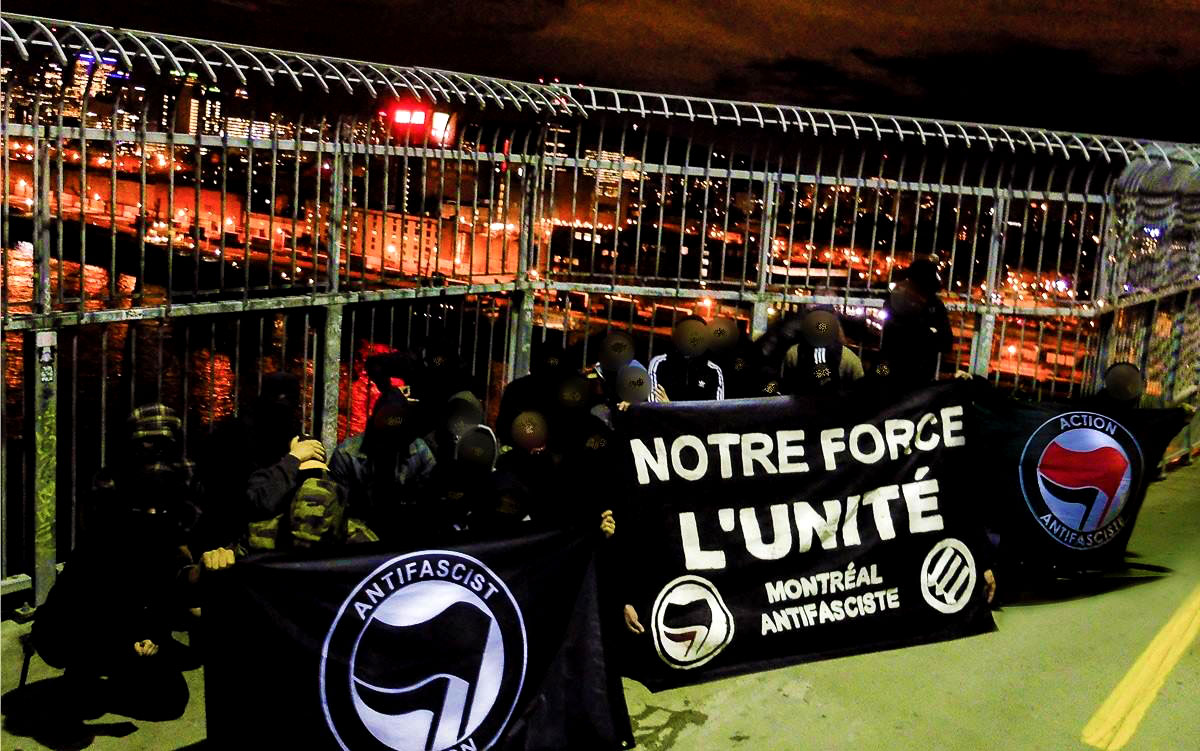
Montréal Antifasciste is a grassroots collective dedicated to combating the rise of the far right in Montréal and Québec. Its website can be found at http://www.montréal-antifasciste.info.
Bibliography
Maxime Aurélien and Ted Rutland, Il fallait se défendre: L’histoire du premier gang de rue haïtien à Montréal (Montréal: Mémoire d’encrier, 2023).
Acouette Junior Jocy, Poseurs? Scalpeurs de skins de la L.A.M. (Paris: Librinova, 2009).
Anonymous, Cops and LAM Go Hand in Hand, Antifa Forum, vol. 2, (197), 8–15; available at : https://montreal-antifasciste.info/en/cops-and-lam-go-hand-in-hand/
Shannon Clay, Lady, Kristin Schwartz, and Michael Staudenmaier, We Go Where They Go: The Story of Anti-Racist Action (Oakland: PM Press, 2023).
* [In accordance with the policy of the journal Possibles, this article may be reproduced, in whole or in part, provided that the source is clearly cited and, where applicable, it is specified that this is only an excerpt.]